


『Dilute sulfuric acid flowmeter』Related information(clamp on meter|electromagnetic meter|venturi meterrotameter|orifice meter|ultrasonic flow meter|mass flow meter|coriolis mass flow meter|coriolis flow meter|magnetic flow meter|magmeter flow meter|magflow flow meter|mag meter flow meter|electromagnetic flow meter|vortex flow meter|turbine flow meter|thermal mass flow meter|thermal flow meter|rotameter flow meter)

Is the gas mass flow meter user-friendly?
2. Why cant concentrated sulfuric acid be stored in an open container?
Concentrated sulfuric acid has strong water absorption, dehydration, and oxidation properties, and should be sealed and stored in an open container. Concentrated sulfuric acid will continuously absorb moisture from the air and surrounding environment, gradually becoming dilute sulfuric acid. If there is a liquid that can react with concentrated sulfuric acid, it will also cause it to deteriorate..
3. How to prepare ammonium bisulfate
There are two main methods for preparing ammonium bisulfate, and the specific operations are as follows
1. Reaction method between sulfuric acid and ammonia • Reaction principle: H ₂ SO ₄+NH ∝ → NH ₄ HSO ₄ (generated when ammonia is insufficient) • Operation process: 1 Use a glass flask in a fume hood to hold dilute sulfuric acid (recommended concentration of 20% -30%) Control the ammonia flow rate through a flow meter (recommended 0.5-1L/min). 3. Keep the temperature of the cold water bath below 40 ℃. 4 Monitor with pH test paper, and control the endpoint pH value between 1.5-2.5 Evaporate and concentrate in an 80 ℃ water bath until a crystal film 6 appears on the liquid surface Cool to room temperature for crystallization, filter and dry at 50 ℃ Ammonium sulfate and sulfuric acid reaction method • Reaction principle: (NH ₄) ₂ SO ₄+H ₂ SO ₄ → 2NH ₄ HSO ₄ • Operation process: 1 Weigh ammonium sulfate and 98% concentrated sulfuric acid in a 1:1 molar ratio Slowly add concentrated sulfuric acid (no more than 5ml per minute) under ice water bath conditions. 3. Maintain the reaction temperature at 100-120 ℃ and stir for 2 hours. 4 Natural
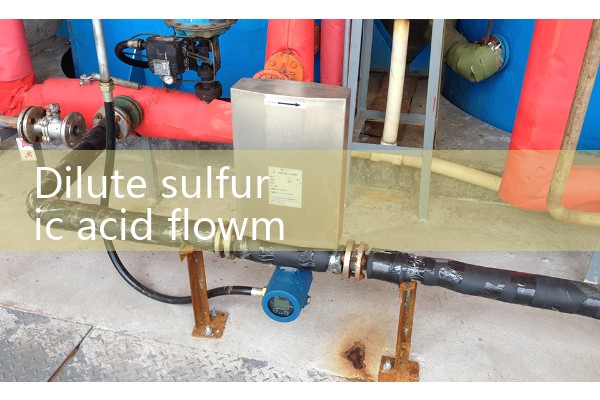
4. Selection reference for electromagnetic flowmeter electrodes under different fluid media.
The selection of electromagnetic flowmeter electrodes should be based on the corrosiveness, wear resistance, and working conditions of the fluid media. Common electrode materials and applicable scenarios are as follows.
1. 316L stainless steel electrodes are suitable for slightly corrosive media such as water, sewage, inorganic acids (such as dilute sulfuric acid and phosphoric acid), organic acids (such as acetic acid), etc.
The sentence is:. Features: Low cost, strong resistance to uniform corrosion. Not suitable for working conditions with chloride ions (such as seawater) or strong oxidizing acids. Typical scenarios: Measurement of clean water or weakly corrosive liquids in municipal water supply, sewage treatment, and general chemical processes2. Suitable media for Hastelloy B (HB) electrodes: all concentrations of non oxidizing acids such as hydrochloric acid (below boiling point), sulfuric acid, phosphoric acid, hydrofluoric acid, etc. Alkali solution, non oxidizing salt solution (such as sodium chloride solution). Characteristics: It has strong corrosion resistance to non oxidizing media, but is not suitable for media containing oxidants (such as nitric acid)
 Hot Blog
 Related AD