

『Culligan Water Softener Flow Meter Not Working: Diagnostic Fault Checklists』Related information(clamp on meter|electromagnetic meter|venturi meterrotameter|orifice meter|ultrasonic flow meter|mass flow meter|coriolis mass flow meter|coriolis flow meter|magnetic flow meter|magmeter flow meter|magflow flow meter|mag meter flow meter|electromagnetic flow meter|vortex flow meter|turbine flow meter|thermal mass flow meter|thermal flow meter|rotameter flow meter)
Culligan Water Softener Flow Meter Not Working: Diagnostic Fault Checklists
Quick Answer: A Culligan water softener flow meter usually stops working because the turbine is jammed with resin fines, the Hall sensor is fouled, the cable is damaged, or the controller lost its pulse scaling. Start with the zero reading checklist and a voltmeter test before replacing the meter. For repeat failures, a Silver Instruments EMF magnetic flow meter in DN15 to DN50 removes the moving parts that cause most Culligan meter faults.
Why the Culligan Flow Meter Fails in Softener Service
Culligan softener systems often use an insertion turbine flow meter between DN20 and DN25. It sends a square wave pulse to the valve controller. The turbine sits in water with small amounts of resin fines, iron flake, and salt brine from the regeneration cycle. Those particles are abrasive. After two or three years the turbine shaft wears. The bearing play increases. The rotor wobbles and the pulses become unstable. We have seen this on customer sites in the Philippines, Saudi Arabia, and Malaysia. This is the starting point for most diagnostics.
Zero Flow Reading Checklist
If the display shows zero flow but water is moving, follow this sequence. First close the bypass and confirm the softener inlet valve is open. Second, look at the flow meter body for a visible crack or leak. Third, remove the sensor from the tee or saddle. Inspect the rotor. If resin fines block the rotor, clean it with a soft brush and clean water. Fourth, check the Hall sensor tip for a black coating. Wipe the tip with a wet cloth. Fifth, inspect the cable between the meter and the controller. Rodents and UV damage cause many zero reading faults. A food factory in Ho Chi Minh City lost the flow signal because rats chewed the sensor cable inside a cable tray. Sixth, measure the supply voltage at the sensor connector. Most Culligan pulse meters accept 5 to 24 V DC. A missing voltage points to the controller board or the wiring. Here is the thing. Most engineers skip the cable check and spend money on a new sensor. Do not do that.
Unstable Reading or Half Volume Checklist
When the meter counts flow but the volume is low or the reading jumps, check three things. Air pockets hit the turbine and produce false counts. This happens when the brine draw line has a small leak. The K factor on the controller may also be wrong. In practice, a K factor reset causes more low volume errors than a worn rotor. We have seen this after controller board replacements in Vietnam and Peru. A third cause is rotor wear. Spin the rotor by hand. If it wobbles or scrapes the housing, replace the sensor. Because the K factor changes with bearing wear, a cleaning job will not fix a worn rotor.
How to Test the Pulse Output with a Multimeter
Set a digital multimeter to frequency or Hz. Connect the black lead to the signal negative and the red lead to the signal output. Blow lightly through the flow meter or spin the rotor with a small brush. The frequency should increase smoothly. A stuck high or low frequency points to a damaged Hall sensor. If the frequency is correct but the controller still shows zero, the input circuit on the controller is bad. Do not replace the flow m
When to Replace the Culligan Flow Meter with a Magnetic Flow Meter
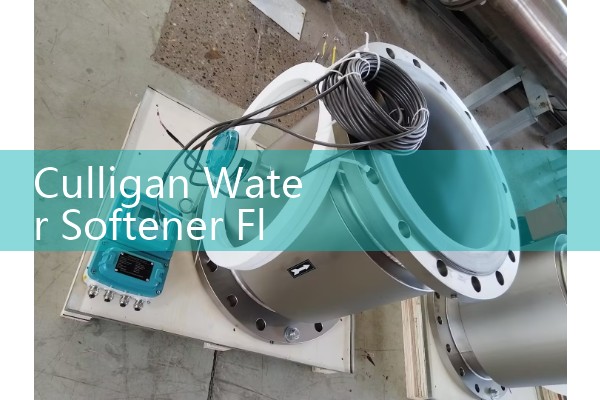
If the Culligan sensor fails twice in one year, or if the water contains a lot of iron sediment, a replacement is cheaper than repeat service calls. A magnetic flow meter has no rotor, no Hall sensor, and no moving parts inside the pipe. Silver Instruments supplies an EMF series electromagnetic flow meter in DN15, DN20, DN25, DN40, and DN50 with PTFE liner and 316L electrodes. It outputs 4-20 mA with HART, pulse, and RS485. Accuracy is 0.5 percent of reading for flow from 0.1 to 10 m/s in water with conductivity above 20 µS/cm. That covers most softener feed water and brine solutions.
One Replacement Example on a Softener Line
A water treatment contractor in Cebu replaced a Culligan turbine meter on a 2 inch softener line with a Silver Instruments EMF DN40 electromagnetic flow meter. The old meter was clogging every six weeks with fine resin from a broken lower distributor. The EMF meter weighs about 6.5 kg and has no moving parts in the flow stream. The contractor kept the same controller input using the 4-20 mA signal. That solved the repeat fault. We matched the liner and process connection from the old meter photos and the pipe size.
Quick FAQ for Culligan Softener Flow Meter Problems
Why does my Culligan softener show no water flow during regeneration?
The turbine may be stuck, the Hall sensor may be coated, or the controller may not get a pulse. Check the rotor and cable first, then check voltage at the sensor connector.
Can I clean the Culligan flow meter sensor instead of replacing it?
Yes, if the rotor spins freely after cleaning and the pulse test is smooth. If the rotor wobbles or the Hall sensor is cracked, replace the meter.
What is the typical K factor for a Culligan turbine flow meter?
The K factor varies by model and pipe size. Common values sit between 0.4 and 1.5 pulses per litre for small softener meters. Always copy the K factor from the old sensor label before disposal.
Will a magnetic flow meter work with softened water and brine?
Yes. Softened water and dilute brine normally have conductivity above 50 µS/cm. A magnetic flow meter from Silver Instruments works above 20 µS/cm. It also handles the salt regeneration flow without clogging.
How do I send Silver Instruments the correct sizing details for a replacement?
Send us the pipe size (DN), flow range (m3/h or GPM), pressure (bar), temperature (°C), and water conductivity (µS/cm). We will reply with a quotation within 24 hours.
Contact and Next Step
For a replacement magnetic flow meter or diagnostic confirmation, contact Silver Automation Instruments by Tel: +86-25-68650347, Whatsapp: +86-25-52155837, WeChat: +86 15365082610. We supply industrial flow meters and pressure transmitters to customers in Southeast Asia, Oceania, Latin America, Africa, and the Middle East. You can also visit flow-meter.com.au for product details. Send us your pressure (bar), temperature (°C), pipe size (DN), and flow range. We will match a Silver Instruments EMF meter to your softener line.
 Hot Product
 Related AD