

『Sunflower Oil Flow Meter DN50: Optimizing Tri-Clamp Sanitary Pipeline Configurations』Related information(clamp on meter|electromagnetic meter|venturi meterrotameter|orifice meter|ultrasonic flow meter|mass flow meter|coriolis mass flow meter|coriolis flow meter|magnetic flow meter|magmeter flow meter|magflow flow meter|mag meter flow meter|electromagnetic flow meter|vortex flow meter|turbine flow meter|thermal mass flow meter|thermal flow meter|rotameter flow meter)
Sunflower Oil Flow Meter DN50: Optimizing Tri-Clamp Sanitary Pipeline Configurations
Quick Answer: A DN50 sanitary oval gear flow meter with Tri-Clamp connections gives you reliable batch accuracy for sunflower oil, no straight pipe runs required. Viscosity values between 30 cP and 80 cP do not upset the meter. Send us your flow range in L/min and oil temperature, and we will propose a ready-to-install Tri-Clamp meter set.
Sunflower Oil Demands a Sanitary, Positive Displacement Meter
Sunflower oil viscosity shifts with temperature. At 20 °C you see around 60 cP. At 35 °C it drops to roughly 35 cP. A turbine or electromagnetic meter loses repeatability when viscosity moves around. An oval gear meter locks volume pockets between two precision lobes and passes a fixed volume per rotation. You get 0.5 % or 0.2 % accuracy across the whole batch no matter if the oil is cool or warm. In the food industry this matters. A filling station that over-doses by 0.8 % on every 1 000 L IBC tote wastes 8 litres of oil per container. That leak adds up fast when you ship 40 containers a day.
Silver Automation Instruments builds oval gear meters with all-wetted 316L stainless steel, food-grade PEEK or PTFE gears, and Tri-Clamp sanitary ends. We size the DN50 body for flow rates between 20 and 200 L/min — the sweet spot for many bottling and transfer lines in Southeast Asia and the Middle East.
Why DN50 Tri-Clamp Instead of Threaded or Flanged
Tri-Clamp connections remove dead zones. A DN50 Tri-Clamp ferrule sits flush with the pipe bore. There is no cavity where sunflower oil can sit, oxidize, and form a biofilm. CIP and SIP cycles clean the meter without disassembly when you keep the line velocity above 1.5 m/s. Plants in Thailand and Malaysia that run hot caustic flush at 80 °C appreciate this.
DN50 matches common 2-inch OD tubing (50.8 mm outside diameter) with a clamp size of 64 mm. The gasket choice is often PTFE envelope or FDA EPDM. Silicone O-rings are an option for high-temperature sunflower oil up to 150 °C. We always ask for the cleaning temperature and the chemical agent before specifying the seal material. A wrong seal swells and leaks within three CIP cycles.
Real-World Pipeline Configuration: A Setup We Shipped to Vietnam
Last year a sunflower oil contract packer in Ho Chi Minh City contacted us. They needed to fill 20 L pails on a rotary filling machine. The old turbine meter drifted 1.5 % when viscosity changed after startup, so the line operator adjusted the fill time manually three times per shift. We installed a DN50 oval gear meter with Tri-Clamp ends right after the product buffer tank and a 60-mesh Y-strainer. The strainer catches seed particles and prevents gear sticking. The meter was mounted 150 mm downstream of the strainer, no additional straight run needed.
The filling accuracy went to ±0.3 % on every pail. The plant eliminated manual trim adjustments. The operator just started the batch selector on the batch controller we supplied and walked away. Power came from a 24 V DC loop, signal output was pulse (Hall effect sensor) to the filling PLC. Temperature of the oil stayed at 20 to 25 °C, well inside the meter limits.
Most engineers skip the strainer. We have seen this on many customer sites. But sunflower oil often carries minor sediment from cold-pressing. A 400-micron mesh screen before the meter saves you from pulling the gears out every quarter. The strainer body should also be Tri-Clamp so you can drop the screen and rinse it in 30 seconds between batches.
How to Size the Meter and Avoid Air Binding
Oval gear meters displace a known volume per pulse. For sunflower oil of density 0.92 kg/L, a DN50 chamber usually gives 10 to 20 mL per pulse depending on the gear design. Convert your target flow rate to L/min and check if the meter stays between 10 % and 100 %
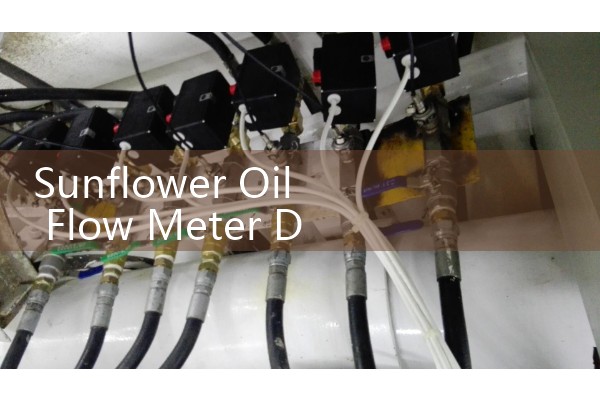
Air binding is the main headache. A small gas pocket inside the measuring chamber makes the gears free-spin and count phantom volume. Position the meter below the supply tank liquid level or install a float-type air eliminator upstream. Tri-Clamp mounts make it easy to tilt the meter slightly downward so bubbles drift toward the outlet and do not collect. We send a simple mounting guideline with every order.
Signals and Integration into Your Filling Skid
Most customers ask for a dual-channel output: a pulse train for the batch controller and a 4-20 mA signal for the SCADA. Silver Instruments can supply a 4-20 mA HART board inside the housing, plus an ATEX-approved magnetic pickup for Zone 1 if you process sunflower oil in an area classified because of hexane extraction. For simple standalone use, a local LCD display with two stage batch relays works directly on the meter head. You set high and low flow alarms without a PLC.
Plant engineers in the Middle East often connect our RS485 Modbus output to their Siemens or Rockwell PLC. We provide the register map and default baud rate of 9600. If you need a PROFIBUS DP interface, we add a converter module in a separate junction box. Keep the cable run below 200 meters for pulse signals, use shielded twisted pair, and ground the shield at the receiving end only.
What to Send Us for a Quotation
We prepare a price for the meter, matching Tri-Clamp gaskets, clamps, and a sanitary strainer in one package. To do that we need your actual process numbers. Write to [email protected] with these five data points:
Oil inlet temperature in °C, flow range in L/min (min, normal, max), pipe tube OD in mm or DN, cleaning temperature and chemical type, and required signal output (pulse, 4-20 mA, Modbus). We respond within one working day. See the complete Sanitary Oval Gear Meter range on flow-meter.com.au.
FAQ
Q: What flow rates can a DN50 oval gear meter handle with sunflower oil?
A: Typically 20 to 200 L/min for oil of 35 cP to 80 cP. The exact range depends on gear clearance and signal resolution. We size the meter so your normal flow rate falls near 60 % of the maximum rated flow.
Q: Does the Tri-Clamp DN50 meter need a straight inlet run like a magnetic meter?
A: No. Oval gear meters are volumetric and ignore flow profile disturbances. You can mount the meter directly after a 90-degree bend or a strainer.
Q: Can the meter survive Clean-in-Place with hot caustic solution?
A: Yes. Choose a meter with PTFE or PEEK gears and perfluoroelastomer (FFKM) O-rings. These materials withstand 2 % NaOH at 85 °C for 20-minute cycles. Inform us during ordering so we assemble the correct wet-end components.
Q: What accuracy can we expect with sunflower oil at varying temperatures?
A: Typically ±0.5 % of reading between 20 °C and 60 °C oil temperature. With linearization in the converter we can bring that down to ±0.2 % over a defined range. We test every meter against a master calibration rig before shipping.
Q: How do we prevent sunflower oil residue hardening inside the meter during shutdown?
A: Flush the line with warm oil or a neutral food-grade cleaning fluid before a long stop. Do not leave the meter full of oil in a cold environment below 10 °C. If a plant shutdown is planned, remove the meter from the line, wash the chamber, and store it dry with the clamps loose. This sequence prevents gummy deposits from locking the gears at the next startup.
 Hot Product
 Related AD